
All Types of Pliers and Their Uses: A Buyer's Guide from Your Hardware Shop in Deira
Combination, long nose, diagonal, slip joint, water pump, locking, circlip and more: every type of pliers explained, with uses. Hardware shop in Deira, Al Quoz, Qusais.
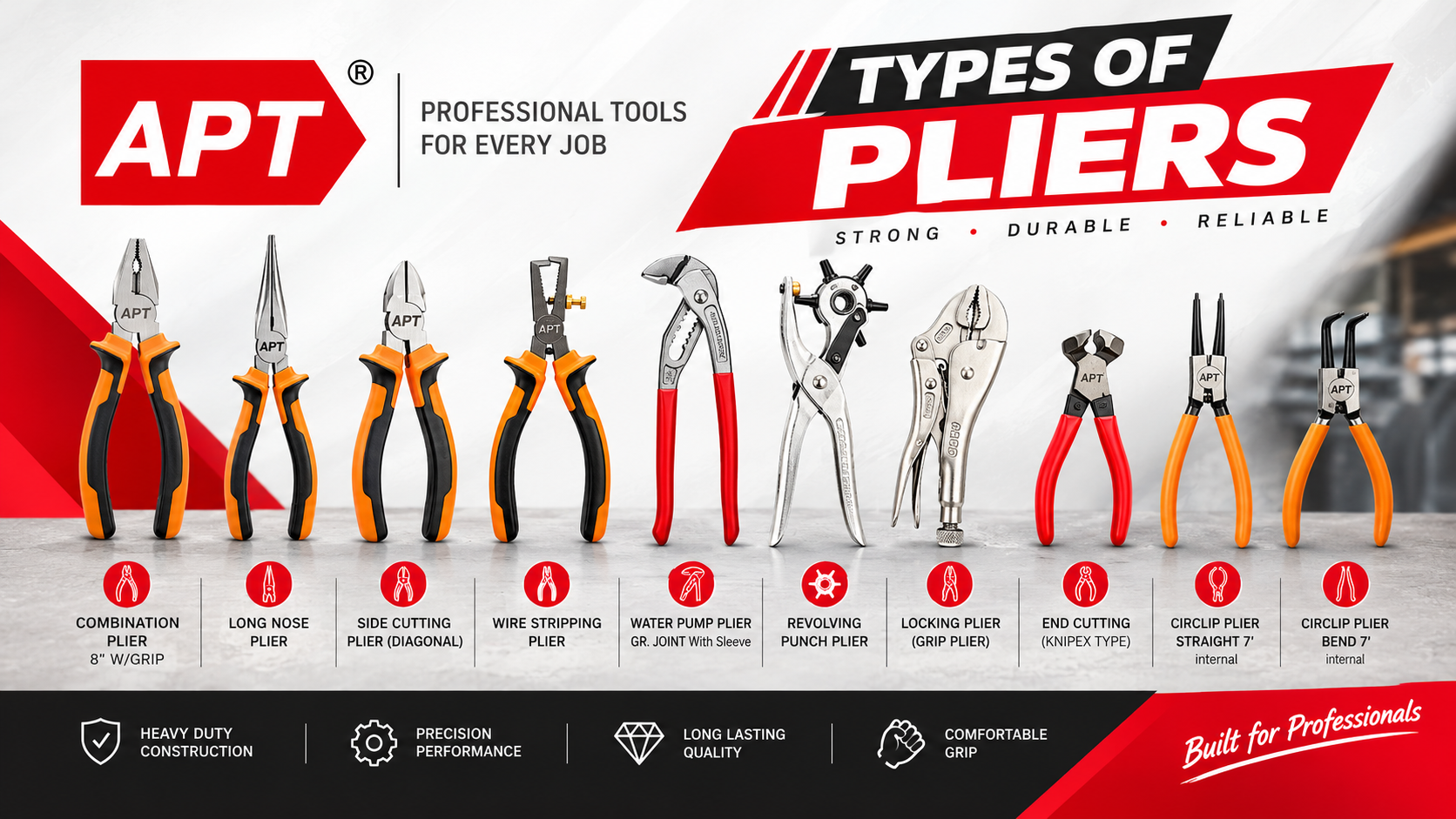
Pliers are hand tools that grip, bend, twist, crimp or cut, and each type is shaped for one of those jobs. The main types are combination pliers (general gripping and cutting), long nose pliers (reaching into tight spaces), diagonal cutters (snipping wire), slip joint pliers (adjustable grip), water pump pliers (pipes and large nuts), locking pliers (clamping hands-free), circlip pliers (fitting retaining rings), crimping pliers (electrical terminals), end cutters (nails and rivets), fencing pliers, tile nippers and bent nose pliers. A tradesman's basic kit is a combination, a long nose, a diagonal cutter and a water pump pliers. All of these are stocked at Safinat Group, your hardware shop in Deira at Nakheel Centre, Naif, and at our Al Quoz and Al Qusais branches.
What makes one pliers different from another
Every pliers has the same four parts: jaws, a pivot, handles and, on most, a cutting edge near the pivot. What changes is the jaw shape and the pivot position. A short, wide jaw close to the pivot gives gripping force; a long, slim jaw gives reach; a jaw that slides on the pivot gives adjustment; and a jaw with a toggle lock gives clamping. Choosing by jaw rather than by name is the quickest way to pick the right tool at the counter.
The other things that separate a tool that lasts from one that does not: the steel (chrome vanadium is the standard for trade pliers), the finish (polished, chrome-plated or black-oxide, which resists rust in Dubai's humid summers), the handle (dipped PVC for grip, or insulated to 1,000 volts for electrical work) and the cutting edge (induction-hardened edges stay sharp longer on steel wire).
The 12 types of pliers and what each is for
1. Combination pliers (lineman's pliers)
Flat serrated gripping jaws at the tip, a round pipe-grip section in the middle and a wire cutter next to the pivot. If a workshop owns one pliers, it is this one. Sizes are 6, 7 and 8 inch; 8 inch gives the most leverage for cutting.
Uses: gripping and twisting wire, pulling nails, bending flat bar, cutting cable and mild steel wire, general assembly.
2. Long nose pliers (needle nose)
Long, tapering jaws, usually with serrations and a small cutter at the base. The reach lets you hold a screw, washer or spring where fingers cannot go. Half-round versions bend wire into loops.
Uses: electrical work, fitting small furniture fittings and hinges, retrieving dropped parts, bending wire loops, jewellery and electronics.
3. Diagonal cutting pliers (side cutters)
Angled cutting jaws that meet at a point, with no gripping surface. The angle lets you cut flush against a surface. Insulated versions are used by electricians.
Uses: cutting copper wire, cable ties, nails flush, plastic sprue, zip-tie tails.
4. Slip joint pliers
A two-position pivot slot that lets the jaws open wider for larger items. Flat serrated tips and a curved pipe-grip section. The low-cost general pliers found in most household toolboxes.
Uses: household repairs, holding nuts, light plumbing, bending metal tabs.
5. Water pump pliers (groove joint / tongue and groove)
Long handles with a multi-position pivot that slides along grooves, so the jaws open to 50 mm or more while staying parallel. The jaw angle grips round pipe without slipping.
Uses: plumbing, holding pipes and large nuts, tightening hose clamps, gripping fittings during tile and sanitary installation.
6. Locking pliers (vice grip / mole grip)
A toggle mechanism locks the jaws closed with an adjustable screw in the handle. Once set, the tool clamps without hand pressure. Curved-jaw, straight-jaw, long nose and C-clamp versions are available.
Uses: holding parts for welding, removing rounded-off bolts, clamping two panels while screws go in, holding a stripped screw head.
7. Circlip pliers (snap ring pliers)
Fine pointed tips that fit into the holes of a circlip (retaining ring). Internal circlip pliers close the ring to fit it inside a bore; external pliers open the ring to fit it on a shaft. Some sets have interchangeable straight and bent tips.
Uses: power tool and motor repair, bearings, gearboxes, pneumatic cylinders.
8. Crimping pliers
Jaws with shaped dies that compress a terminal or ferrule onto a wire. Ratchet types release only when the crimp is fully formed, giving a consistent joint.
Uses: electrical terminals, insulated and non-insulated lugs, bootlace ferrules, RJ45 and coaxial connectors with the matching die.
9. End cutting pliers (nippers)
Cutting edges at right angles to the handles, so the tool cuts straight down onto the surface. Also called carpenter's pincers or tower pincers.
Uses: pulling and cutting nails, cutting rivets and bolts flush, removing staples, cutting tie wire in reinforcement work.
10. Fencing pliers
A heavy multi-purpose pliers with a hammer face, staple-pulling claws, wire cutters at two positions and a gripping jaw.
Uses: chain-link and wire fencing, driving and pulling staples, cutting and twisting fencing wire, site boundary work.
11. Tile nippers
Hardened carbide-tipped jaws that bite small pieces from the edge of a ceramic tile without cracking it.
Uses: shaping tiles around pipes, sockets and corners; trimming mosaic sheets.
12. Bent nose pliers
Long nose jaws with a 45 or 90 degree bend at the tip, so you can grip at an angle while keeping your hand clear of the work.
Uses: fitting furniture fittings and cabinet hardware in awkward corners, electronics, pulling wire through conduit, holding components at an angle.
Which pliers do I need?
Trade or jobPliers to carryElectricianInsulated combination, long nose, diagonal cutter, crimpingPlumberWater pump (two sizes), locking, slip jointCarpenter / joinerCombination, end cutter, long nose, lockingFurniture and fit-outLong nose, bent nose, combination, lockingSteel fixing / siteCombination 8 inch, end cutter, fencing pliersTilerTile nippers, water pump, combinationMechanic / tool repairCirclip set, locking, long nose, water pumpHousehold toolboxCombination, slip joint, long nose
How to choose a good pliers
- Check the pivot. It should move smoothly with no side play. A loose pivot means the cutting edges will not meet.
- Look at the cutting edges. Hold the closed jaws up to the light; no gap should show along the cutter.
- Match the handle to the job. Dipped PVC for grip and comfort; VDE-marked insulated handles for any live electrical work; plain polished steel where the tool will be heated or used near welding.
- Buy by size, not by price. A 6-inch long nose for cabinet work and an 8 inch combination for wire give better results than one mid-size tool doing both jobs badly.
- Finish for the climate. In Dubai's coastal humidity, black-oxide or chrome-plated pliers hold up better than bare polished steel in a site toolbox.
Pliers for furniture fitting and fit-out work
Anyone fitting furniture fittings in Deira Dubai — cam locks, hinges, drawer runners, shelf supports, connecting bolts — reaches for pliers more than they expect. Long nose and bent nose pliers position small cam dowels and shelf studs; locking pliers hold two panels square while connecting bolts go in; combination pliers straighten bent hinge plates and cut off excess dowel. Safinat stocks the furniture fittings and the pliers in the same aisle, so a joiner can collect both on one visit along with the building materials in Deira that the rest of the job needs.
Where to buy pliers in Dubai
Safinat Group stocks the full range of pliers above, from household sets to VDE insulated and ratchet crimping tools, alongside hand tools, power tools, furniture fittings, locks and building materials.
- Hardware shop in Deira: Safinat Group, Nakheel Centre, Naif, Deira. Phone +971 4 228 5012. Trade counter for pliers, hand tools, furniture fittings and building materials in Deira.
- Hardware shop in Al Quoz: Safinat Al Bahar Building Materials LLC, Al Quoz Industrial Area, +971 55 560 3213; Al Quoz New, 30 First Al Khail Street, +971 54 994 1905.
- Building materials in Qusais: Safinat Al Sahraa Trading Co LLC, Al Qusais, +971 55 576 9729.
Contractors, maintenance companies and workshops can ask any branch for set pricing and bulk quantities. Delivery across the UAE and export to GCC, African and CIS markets is available.
FAQs
What is the most useful type of pliers?
Combination pliers. They grip flat and round items and cut wire, which covers most everyday tasks. Add a long nose and a diagonal cutter and you can handle nearly all general repair work.
What is the difference between long nose and needle nose pliers?
They are the same tool under two names. Needle nose usually describes the slimmer, finer-tipped version used in electronics; long nose describes the slightly heavier trade version.
Which pliers are used by electricians?
Insulated combination pliers, diagonal cutters and long nose pliers rated to 1,000 volts (VDE marked), plus crimping pliers for terminals. The insulation must be on the tool itself, not a loose sleeve.
What are water pump pliers used for?
Gripping pipes, large nuts, hose clamps and sanitary fittings. The sliding pivot opens the jaws wide while keeping them parallel, which is why plumbers carry two sizes.
Can I use locking pliers instead of a spanner?
For removing a rounded-off nut, yes; the serrated jaws bite where a spanner slips. For tightening a good nut, use a spanner, because locking pliers will damage the flats.
Which pliers do I need for furniture assembly?
Long nose or bent nose pliers for placing cam dowels and shelf studs, and a small locking pliers to hold panels square. Both are stocked next to the furniture fittings at our Deira, Al Quoz and Al Qusais branches.
Where can I buy pliers in Deira?
Safinat Group at Nakheel Centre, Naif, Deira. Call +971 4 228 5012 to check sizes and brands in stock.